




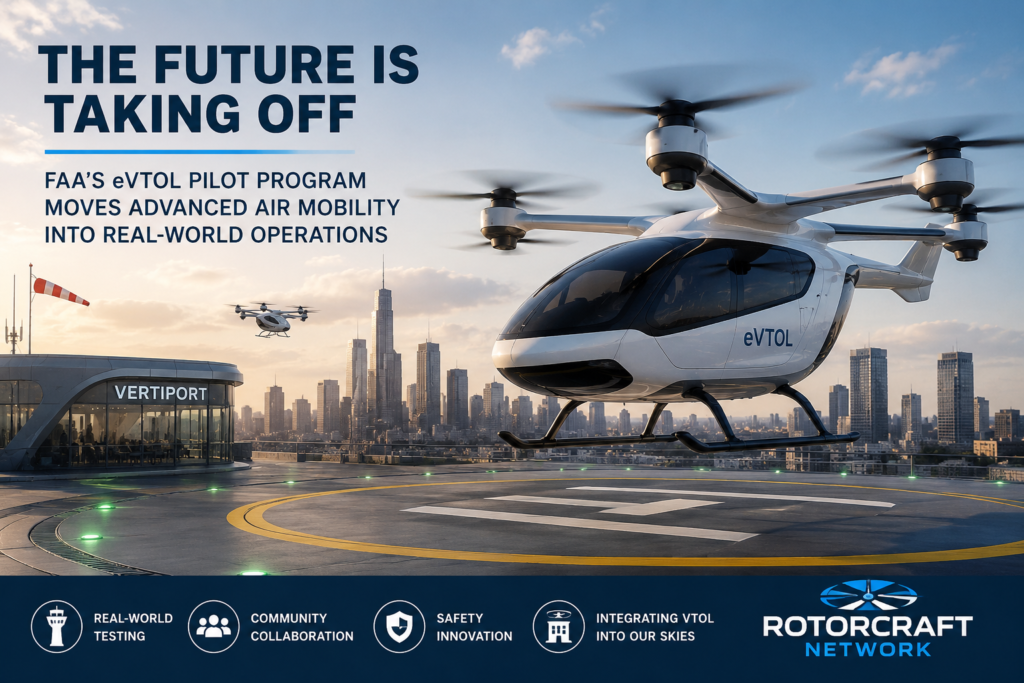
The future of Advanced Air Mobility (AAM) is moving beyond concept demonstrations and into real-world operations. With the Federal Aviation Administration’s eVTOL and Advanced Air Mobility Integration Pilot Program preparing for operational testing, the industry is entering a critical phase that will influence how vertical take-off and landing (VTOL) aircraft are integrated into the National Airspace System.
Unlike early demonstration flights, these pilot projects are designed to gather operational data across a variety of real-world missions, including passenger transportation, cargo delivery, emergency medical services, and infrastructure support. The objective isn’t simply to prove that eVTOL aircraft can fly—it’s to understand how they can safely operate alongside helicopters, general aviation, and commercial airline traffic.
For the rotorcraft industry, this is an important milestone.
Rotorcraft operators have decades of experience conducting complex missions in congested airspace, from helicopter emergency medical services and offshore transportation to utility work and public safety operations. Many of the operational challenges facing eVTOL aircraft today—airspace coordination, weather considerations, pilot workload, maintenance, and community acceptance—are areas where the rotorcraft industry already has valuable experience.
The next several years will determine how quickly commercial VTOL operations can expand. Success will depend on more than aircraft certification. Vertiport development, maintenance standards, pilot training, charging infrastructure, and regulatory frameworks will all play significant roles in bringing AAM into everyday operations.
Rather than viewing eVTOL aircraft as competitors, many professionals see them as an expansion of the broader vertical flight ecosystem. As new technologies mature, collaboration between traditional rotorcraft operators, manufacturers, regulators, and emerging AAM companies will be essential to building a safe and sustainable future.
The FAA’s pilot program represents more than a series of flight demonstrations—it is an opportunity to establish the operational foundation that could define vertical flight for decades to come.
Join the Discussion
As eVTOL operations move from testing into real-world environments, what do you believe will be the biggest challenge to widespread adoption?
- Aircraft certification
- Airspace integration
- Pilot training
- Vertiport infrastructure
- Public acceptance
- Something else?
Share your perspective in the comments. The future of vertical flight will be shaped not only by new technology, but also by the professionals who operate, maintain, regulate, and support it every day.

Get involved!
Comments